An litir dhearg
Bí ar an eolas! Faigh ár nuachtlitir le bheith suas chun dáta leis na feachtais ar fad.
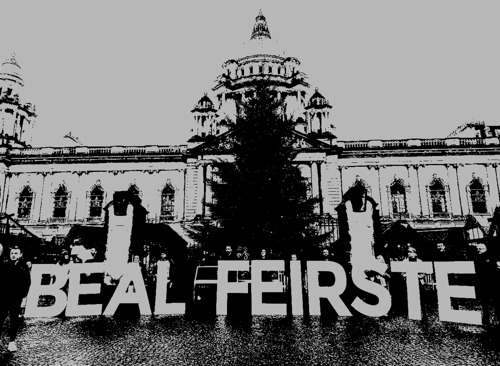
… a phrase that has become popularised by opponents of the Irish language which, ironically, is often followed by a whole host of reasons as to why they are opposed to it; how they have no desire to see it, hear it or use it, how much it costs, how its placement alongside English could be cause for offence, how its display could place staff in jeopardy, how the provision of its rights should be dependent on the majority. The list goes on.
In recent months, as political unionism has ramped up their attacks on the Irish language, I am often reminded of a quote from Franklin Leonard, who tells us that ‘equality can feel like oppression when one is accustomed to privilege’. The reality that political unionism must come to terms with is that their long reign of supremacy is over and confined to history. As gently put by Suzanne Breen in her Belfast Telegraph column over the weekend, “Belfast has changed politically and demographically… The power dynamic once at play in City Hall is not coming back.”
The Irish language is undergoing an enormous, inspiring community-led revival, which is drawing national and international praise and attention. An Ghaeilge is being embraced and celebrated by more people than ever and contrary to what the DUP and others would like you to believe, this is happening and is being welcomed right across society.
Following the passage of the Irish language act through Westminster, the direction of travel is clear, yet political unionism continues to preside over a culture of intolerance, limited progress and blatant obstruction in the hope to disempower those who seek to develop and progress the language. They have demonstrated time and time again that there are no lengths to which they will not go to ensure that the Irish language is excluded from public life.
In recent times, we have seen the DUP reverting to their familiar tactics of kicking the Irish language to the curb, mainstreaming overt intolerance to the language and standing by whilst threats of a hostile community response become headline responses in opposition to language development efforts.
They have called in a decision to erect dual language signage in a shared, city-wide leisure centre, which is used on a weekly basis by an Irish-medium school. One basis of the challenge was that the erection of Irish alongside English on signage had the potential to negatively impact those who did not want to see it. This decision led to a 14-week public consultation, numerous consultation sessions, input from experts, countless reports, a wealth of staff time and resources. Cost was never cited as an issue, nor was it ever disclosed.
DUP MP Carla Lockhart missed her first day of Parliament to appear at a council committee to speak in opposition to the first ever application for dual language street signage in Armagh City, Banbridge and Craigavon Council which met the ridiculously high thresholds. That street sign was supported by 64 residents, and opposed by 3. So much for the DUP supporting dual language signs “where they are clearly wanted”.
Foras na Gaeilge is the body responsible for the promotion of the Irish language throughout the island of Ireland. They announced devastating cuts across the Irish language sector at the beginning of the year. Foras receives 25% of its funding from the northern government and 75% from the southern government. If there is extra money available from one government to allocate to Foras na Gaeilge’s budget, the funding agreement stipulates that they cannot allocate it without the equivalent being available from the other government. Earlier this year, the DUP blocked a reform of this funding agreement from appearing on the agenda for the Executive.
Subsequently, the Department in charge of the Irish language in the south had to send over €1.5m earmarked for Foras na Gaeilge back to the exchequer, quite simply because there was no legal mechanism to get that money into the cross-border body due to the intransigence from the DUP Communities’ Minister.
That same DUP Minister, Gordon Lyons, a minister with primary responsibility for the promotion and development of the Irish language, intervened in a legal case to challenge a decision by another minister to erect dual language signage in Ireland’s largest transport hub. Media platforms are fond of click-bait headlines, but for the purpose of clarity, the signage would place Irish alongside English, not replacing it. No English language signs will be hurt in the process of erecting dual-language signs.
Whilst reporters and opponents are the first to label the Irish language as something ‘controversial’, let us be very clear; the pursuit of equality and rights is not controversial. The denial of rights is. ‘Levelling-up’ Irish does not mean ‘levelling-down’ English.
Most recently, Belfast City Council, ratified a progressive, comprehensive, rights-based Irish language policy which will change the linguistic landscape of the entire city and will place the Irish and English language on equal footing across council facilities, platforms and resources. The DUP’s opposition has been centred around their concerns as to the cost implications of this ‘imposition’ on rate payers, as well as the potential threat of violence to staff who dare to wear a dual language logo on their uniform; English and Irish, side by side. A shared space.
Whether the DUP like to believe it or not, Irish language speakers are ratepayers in this city and have long paid rates to an institution that facilitated their exclusion. We have moved past that; Béal Feirste is the indigenous name of this city and soon that will appear alongside English across the council. That is the physical manifestation of equality. We are taking an enormous step in recognising, celebrating and solidifying the rights of the Irish language community. This is something which should be welcomed. The policy is there to facilitate those who wish to engage with the Irish language. It will have no impact on those who don’t.
Let’s also be clear; if someone threatens or harms a council worker because they are wearing a dual language logo on their uniform, the Irish language is not the issue there. The platform that the DUP have given to such scenarios, whether they be fictional or not, is dangerous and concerning. Rather, we should be combatting such intolerance by increasing normalisation of the language through increased visibility. That is exactly what the policy aims to do.
The fact of the matter is that political unionism does have a problem with the Irish language; that problem may have its roots in genuine fear or a lack of understanding or maybe even blatant intolerance, but there is no denying the fact that it exists.
The Irish language is not something to be feared. It is something that enriches the lives of everyone who chooses to embrace it. The sooner political unionism realises that, the better.
Bí ar an eolas! Faigh ár nuachtlitir le bheith suas chun dáta leis na feachtais ar fad.